
The page is quiet. That's the whole problem.
A page with one post from two years ago reads as a closed business, and you're not lazy for never posting. The reason is more uncomfortable than that, and it's the same reason most people with a real trade go quiet.

Shirley Woods, Founder, Wee Media
· 4 min read
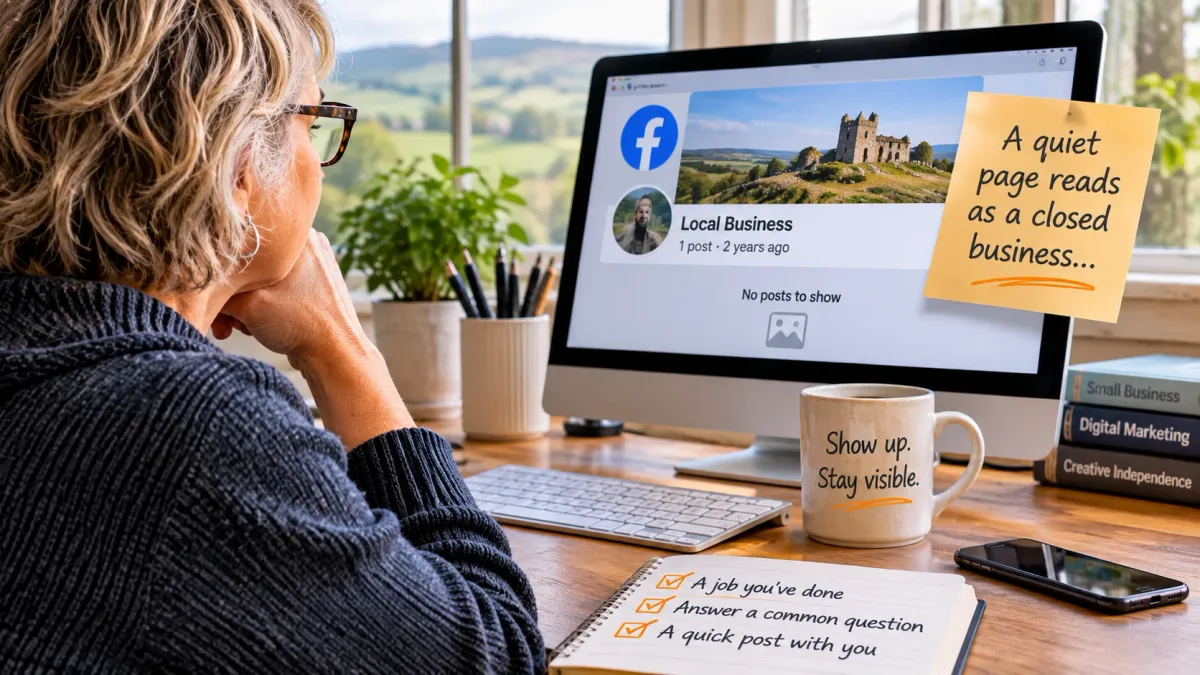
You've been told you need a Facebook page. Or you've got one, and it's sitting there with one post from two years ago and a photo of the front of your building or the side of your van.
Somebody's told you that's your shop window. That you're invisible without it. Maybe you've had a go and stopped, or maybe you've never started because you couldn't think of anything to say that didn't sound like a leaflet.
You might be feeling a bit stupid about it. Don't.
The reason you stopped is not the reason you think.
It wasn't laziness. You can run a business for twenty years; you're not lazy.
The thing that stops people is simpler than that. You'd rather be doing the work than talking about it, and saying "here's a job I did well" out loud makes you feel about twelve. Or you sat down to write something, got three lines in, and heard how it sounded. A bit boastful. A bit American. So you deleted it.
That's what's happening. It isn't a skill you're missing. It's a discomfort, and it's one most people with a real trade feel.
What an empty page actually tells a stranger.
Here's the part that's easier to hear than "you should post more."
When somebody finds a page with two posts and the last one from 2024, they don't think "they must be busy." They think you've packed it in. Fairly or not, a quiet page reads as a closed business, and that's the only impression you've given them to work with.
You don't need to be good at Facebook. You need the page to look like you're still here. There's a gap between those two things big enough to drive a van through.
Three kinds of posts, and that's the whole list.
You don't need trends, dancing, or a plan written on a whiteboard.
The job you just did.
A photo, what it was, and a line on it. You don't need to be proud of it on paper; you just need it to be true.
The question you're asked down the phone ten times a week.
"How much for a full service?" Answer it once, properly, and put it there. Next time somebody asks, you can send the link.
The odd post with you in it.
Because people book people, and a customer wants to know who's coming to the house.
That's it. Not daily. Not even close.
The bit that means it doesn't have to be you.
So here's the awkward question, and I'd rather say it plainly than pretend it isn't the thing on your mind.
You don't owe anyone your own fingers on the keyboard. If standing in front of a camera makes you want to move to Australia, that's not a character flaw, and it isn't a business problem either. Plenty of good local businesses have their page written by a daughter, a mate, or someone they pay a little each month.
The test is one line long: could they write something you'd read without wincing?
If yes, the page gets looked after, and you keep doing the thing you're actually good at. The catch is that whoever writes it has to properly know you, because a page that sounds like a marketing agency is worse than a page that sounds like nothing.
You'd also want to know what happens the week they're on holiday. That's usually where the good intentions fall over.
I can write them for you.
This is the bit where I should be honest about what I do, because you'd have worked it out by paragraph three.
I write the Facebook pages for local businesses already, including an activity centre where the job is getting nervous beginners through the door. All of it is paid work. Neither of them is me posting about my own brilliance, which is exactly why it works.
So if you've read this thinking, "I know the page matters, I'm just never going to be the one writing it", that's a conversation worth ten minutes.
I'd want to know what you do, what you won't do, what you charge, and the questions you're sick of answering.
Then I write the posts, and you read them before they go out. If you'd wince, they don't go out.
It's not a miracle, and it won't make you go viral. It's somebody who knows your business writing the odd honest post so the page doesn't go quiet again. Facebook, or wherever else you've been avoiding.
Tell me a bit about it, and I'll tell you honestly whether I'm the right person. If I'm not, I'll say so.
I'll take it from there.
You don't need both on day one.
A website answers the money question. A Facebook page shows you're still here, and shows a bit of the care. One does the explaining, once. The other does the proof, weekly.
Start with the website if it's one or the other, because that's where a stranger decides whether you're worth the price. Then find the person who'll keep the page ticking over, and be honest with yourself about whether that person is you.
The version where you never look at it again is the version that ends up with a post from 2024 and no enquiries. Whatever you do next, don't leave it quiet.
Written by
Shirley Woods, Founder, Wee Media
I build brochure websites for local businesses. Distinctive design & sharp copy, created together to give customers a compelling reason to choose you.